
Estrangement in The Media (let’s talk about The Beckhams). By Melissa
Hi! I’m Melissa, a returning writer who is back to talk about a more general topic this time, estrangement in the media and the recent chatter about Brooklyn Peltz Beckham. You can also follow me on socials…
Instagram: @_melissa.a.c
Substack: https://substack.com/@mmmelissa?
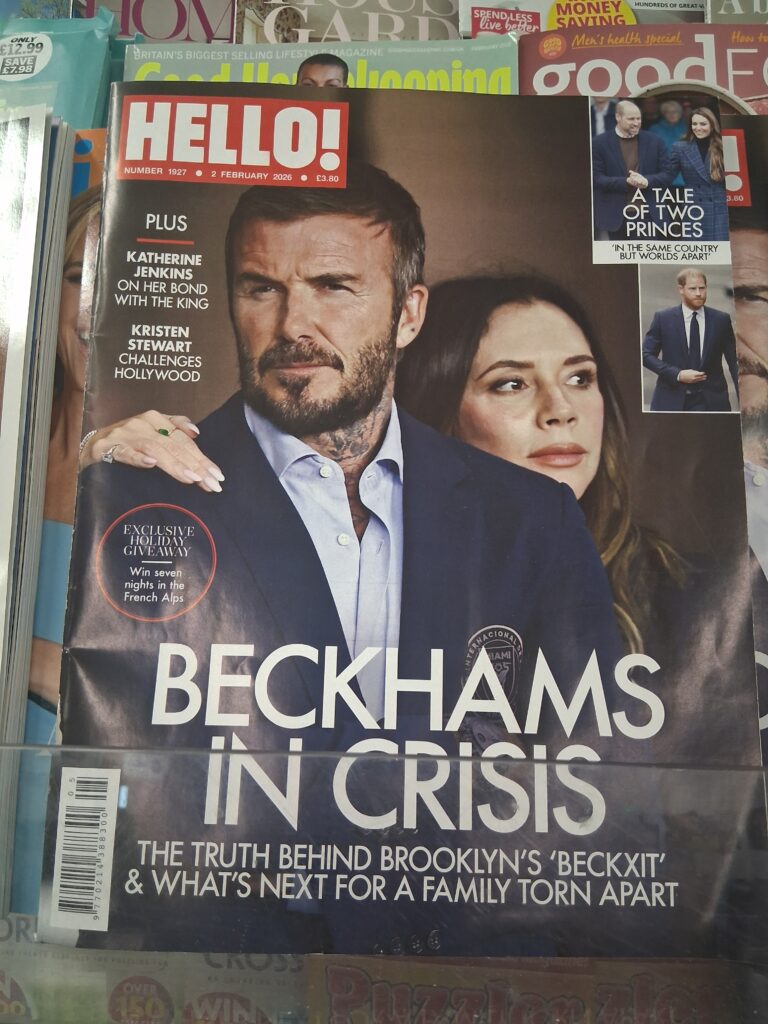
Everyone seems to love the Beckhams. They’re considered pop culture royalty, with a tight knit family and piles of wealth. Everyone was surprised, then, when in January Brooklyn Peltz Beckham – the oldest Beckham child, married to actress Nicola Peltz – issued a lengthy public statement on social media, with a key takeaway: he was estranging himself from his parents and siblings. The media response was instant, and brutal. Tabloids positioned Brooklyn as a destructive force upon the Beckham empire. Comedian after comedian have made viral sketches depicting some of the moments Brooklyn cited in his reasoning for familial estrangement, comment sections full of angry observers, quick to defend the Beckham couple. ‘He’s destroying the Beckham’s brand!’ ‘He’s being so selfish and shouldn’t be airing his family’s dirty laundry in public!’ and, of course: ‘They’ve given him so much!’ And, as always, the woman on ‘the other side’, Nicola Peltz, has been blamed for most of it, with the latest being extensive conversation around her body and weight.
Brooklyn is not the first child of a high-profile parent to declare estrangement. All of Brad Pitt’s six children are estranged from their biological father, and the media has reported on how they’ve discussed their estrangements with deeply biased language, framing Pitt as ‘heartbroken’ and his biological children as having ‘turned against him’. Private Instagram stories, in the instance of Pax Thien Jolie-Pitt, have been leaked and then complained about, as though he has no right to discuss his estrangement either in private or in public. I think what frustrates me the most, though, is the attitude that these now-adult children are supposed to owe their parents something. As though because they grew up as celebrities they are forever indebted to their parents for their fame, and also their wealth – because the general consensus seems to be that a financial support from parents means an emotionally healthy relationship.
I encountered this myself following my own recent parental estrangement after I posted on social media asking if anyone would like a gift card my biological father had gifted to me. One of my peers commented, saying ‘They can’t be that awful if they gave you a voucher.’ Financial support doesn’t equal emotional support. In fact, financial dependency can even be used as a control and manipulation technique in abusive relationships, with the dependent feeling trapped or guilty for their financial aid.
Of course, no-one can truly know the ins and outs of a family they haven’t lived in. But I think it’s dismissive of the complications of estrangement to frame Brooklyn as the villain. Cutting his family off will invariably be massively impacting him: sibling estrangement, as I know only too well, is devastating, and Brooklyn has the world’s eyes on him as he grieves this loss, as well as the loss of his parents. Grieving in private is difficult enough – grieving with the world’s eyes on your every move cannot be any easier. I think a lot of society’s attitude towards Brooklyn Beckham comes from a deep-rooted discomfort when faced with the concept of estrangement. Grief, generally, is a taboo subject – when this grief is centred around loss between living people, there is a central incomprehensibility. It is deeply uncomfortable to face the fact that the people you are biologically related to (or who are deemed ‘family’) can hurt you so much you are driven to no-contact.
For estranged and care experienced students, this is reality, however uncomfortable that may be for you. Rest assured, it’s more uncomfortable for us! So I suppose my message is that you never know what goes on behind closed doors. Community is built around compassion and listening.
Get Involved & Get Supported
Want to write your own blog? Submit a pitch here at https://bit.ly/AoUBlogPitch. Successful blogs are paid at £20.
There are several advocacy and support lines out there for care experienced and estranged students.
- In Wales/Cymru: CE support is from Voices from Care Cymru advocacy line online or at 02920 451431.
- In Scotland/Alba: CE support is from Who Cares? Scotland online or at 0330 107 7540.
- In Northern Ireland: CE support is from VOYPIC online or at 028 9024 4888.
- In England: CE support is from the Care Advice Line (Become) at 0800 023 2033, via WhatsApp at 0786 003 4982, or by email at advice@becomecharity.org.uk. There is also Help at Hand (Children’s Commissioner) at 0800 528 0731 or emailing help.team@childrenscommissioner.gov.uk.
- Together Estranged (TE) is a non-profit that supports and empowers estranged adult children.
- Dunbar Project is a mental health organisation dedicated to addressing the adoptee mental health crisis.
Wider Support
- UniAdvocates are trained Independent Advocates who listen to a student’s concerns, explain options available to them, and facilitate action. Request a UniAdvocate online or contact them at student@adventadvocacy.co.uk or call their office on 01325 776 554.
- The Mix general and specific for young people aged 16-25, and they also have peer support from other young people in The Mix Community.
- Citizens Advice support, which is available across all four nations of the UK, and can be online, in-person or over the phone.
- Money Helper has some guidance on financial abuse: spotting the signs and leaving safely.